Through this guide, you’ll explore what is Agentic RAG, how its retrieval control loop works, how it differs from traditional RAG, the key benefits and enterprise use cases, different Agentic RAG architectures, a practical insurance implementation with LangChain, and the challenges involved in taking these systems into production.
Table of Contents
Introduction
Your RAG chatbot can answer, “What’s the deductible on the Silver plan?” in seconds. But ask, “Why was my water-damage claim only partly paid?” and the same pipeline can confidently pull a clause from a policy version that expired last year. You will notice that the system may be working exactly as designed, where a retriever found a semantically similar passage, the LLM used that context, and the pipeline returned an answer. So what’s lacking is the ability to question whether the evidence was relevant, complete, or still valid.
And this is where Agentic RAG changes the approach. Rather than treating retrieval as a single step before generation, agentic RAG introduces a reasoning and decision-making layer around the retrieval process. The system can break down the question, determine which sources or retrieval strategies are needed, evaluate the evidence it finds, and perform additional searches if a gap needs to be filled for a more grounded response.
According to MarketsandMarkets estimates, the global RAG market will grow from USD 1.94 billion in 2025 to USD 9.86 billion by 2030, with agentic and adaptive RAG emerging as part of the broader evolution of retrieval-based AI. So stay with this complete guide to learn what is agentic RAG, how it differs from traditional RAG, and when the additional complexity is worth introducing.
What is Agentic RAG?
Agentic RAG is a retrieval-augmented generation approach in which an AI agent voluntarily decides how to retrieve, evaluate, and use information before generating a response. It does not use a fixed retrieve-then-generate pipeline; the agent can interpret the question, break it into smaller tasks, and select the right data source or tool, assess evidence to retrieve, and repeat the same process when the available information is not sufficient or reliable.
Consider a RAG pipeline as a research workflow, where a question involves multiple topics, sources, or conditions; the agent can determine what information it requires, decide where to find it, check what it has found, and adjust its approach before producing an answer. This makes retrieval an iterative process rather than a one-time operation. In practice, an agentic RAG system may combine four key capabilities:
1: Query planning and rewriting
The agent interprets the user’s intent and turns broad or ambiguous questions into more precise search queries. For a compound question, it can break the request into multiple sub-queries and address each one separately.
2: Routing and tool use
The agent selects the source or tool most appropriate for each part of the question. A revenue question might require a SQL database, a policy question may use a document or vector store, while current pricing could require a live API. When an answer spans multiple sources, the agent can coordinate retrieval across them.
3: Evidence evaluation and refinement
The agent can assess whether the retrieved information is relevant, complete, consistent, and sufficiently current. If the evidence falls short, it can rewrite the query, search another source, or retrieve additional context before generating an answer.
4: Memory and context management
When supported by the system, the agent can retain relevant conversation context and user-specific information across turns. This allows follow-up questions such as “What about my spouse?” to be interpreted in relation to the earlier discussion rather than as an isolated query.
Build Production-Ready Agentic RAG Systems
Hire AI Agent Developer from Bacancy Technology to build or extend your Agentic RAG solution with the right architecture, tools, enterprise data integrations, and safeguards from the start.
Key Benefits of Agentic RAG for Enterprise AI Systems
Agentic RAG becomes particularly useful when enterprise questions require multiple sources, several retrieval steps, or context that changes from one user to another. Its value comes from giving the retrieval process more flexibility and control.
Higher Accuracy on Complex, Multi-Hop Questions
Agentic RAG simplifies complex questions into smaller queries, retrieves information from multiple sources, and evaluates the results before forming an answer. It makes it better suited to questions that require multiple retrieval steps, cross-referencing, or deeper context.
Combines Structured and Unstructured Data
Enterprise information is spread across databases, documents, APIs, and business systems. Agentic RAG coordinates retrieval across sources and combines the results into a single grounded response. For example, bringing together a claims record, policy clause, and real-time claim status.
Adds a Validation Layer Before Generation
RAG agents evaluate retrieved information for relevance, completeness, consistency, and freshness before using it to generate a response. When the evidence is insufficient, it can search again, use another source, or escalate the request instead of relying on weak context.
Makes Retrieval Workflows More Traceable
Agentic RAG workflows capture query rewrites, retrieval decisions, tool calls, source documents, and evaluation results. This creates a clearer audit trail for debugging, compliance reviews, and investigating how a particular response was generated.
Delivers More Context-Aware Responses
Agents incorporate relevant user, session, and business context into the retrieval process. This allows the same application to tailor responses based on factors such as a user’s role, location, account information, or applicable policy without treating every query as an isolated request.
Agentic RAG vs. Traditional RAG: How the Retrieval Workflow Differs
To understand agentic RAG, it becomes clearer when you place it alongside the retrieval pipeline most enterprise teams already use. The key difference lies in how the system handles the retrieval process: agentic RAG dynamically decides what to search, where to search, and whether the retrieved evidence is sufficient, while traditional RAG generally follows a predefined retrieval flow.
Dimension
Agentic RAG
Traditional RAG
Control flow
Iterative loop: plan, retrieve, evaluate, retry
Fixed, one pass: retrieve then generate
Retrieval passes
One or multiple, based on the query and retrieval results
Typically one
Data sources
Coordinate vector stores, SQL databases, APIs, web search, and other tools
Commonly centered on a vector store or defined knowledge source
Query handling
Rewrite, decompose, or expand the query based on the task
Typically searches the original query or uses predefined rewriting
Retrieval quality
Evaluate retrieved evidence before generation
Retrieved context is generally passed to the generation step
Handling missing evidence
Retry, switch sources, retrieve additional context, or escalate
Depends on the safeguards built into the pipeline
Latency
Increases with additional planning, tool calls, and retrieval loops
Generally lower with fewer processing steps
Cost per query
Can be higher because of additional model calls and tool usage
Generally lower with a simpler execution path
Debugging
Requires tracing across planning, retrieval, tool calls, and evaluation
More predictable execution path
Best suited for
Multi-step, multi-source, ambiguous, or context-heavy questions
Straightforward lookups and well-defined knowledge queries
Agentic RAG enables more flexibility in the retrieval process, but more orchestration does not automatically translate into better results. If the data is poorly chunked, outdated, inconsistently structured, or missing critical metadata, adding an agent may increase latency and cost without fixing the actual issue.
The same principle works when the limitation lies with the model rather than retrieval. If your application requires deeper domain specialization, consistent task-specific behaviour, or tightly controlled output formats, approaches such as RAG vs. fine-tuning may deserve consideration before introducing another orchestration layer.
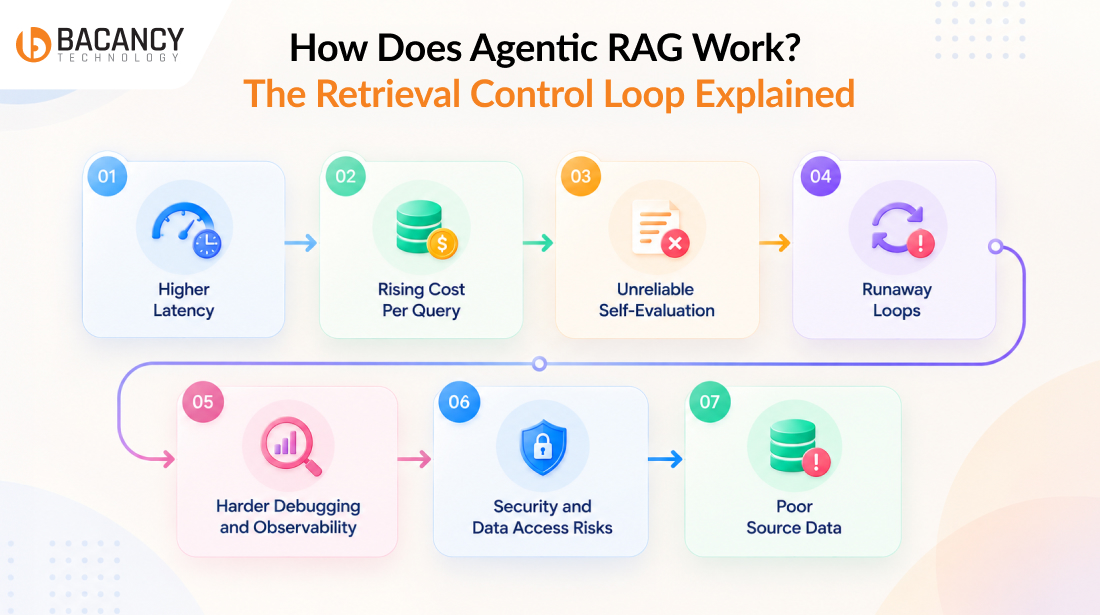
How Does Agentic RAG Work? The Retrieval Control Loop Explained
At its core, agentic RAG puts an LLM agent in charge of retrieval. The agent decides what to search, where to search, whether the results are good enough, and when to stop. Here’s what’s inside the system and how a single query moves through it.
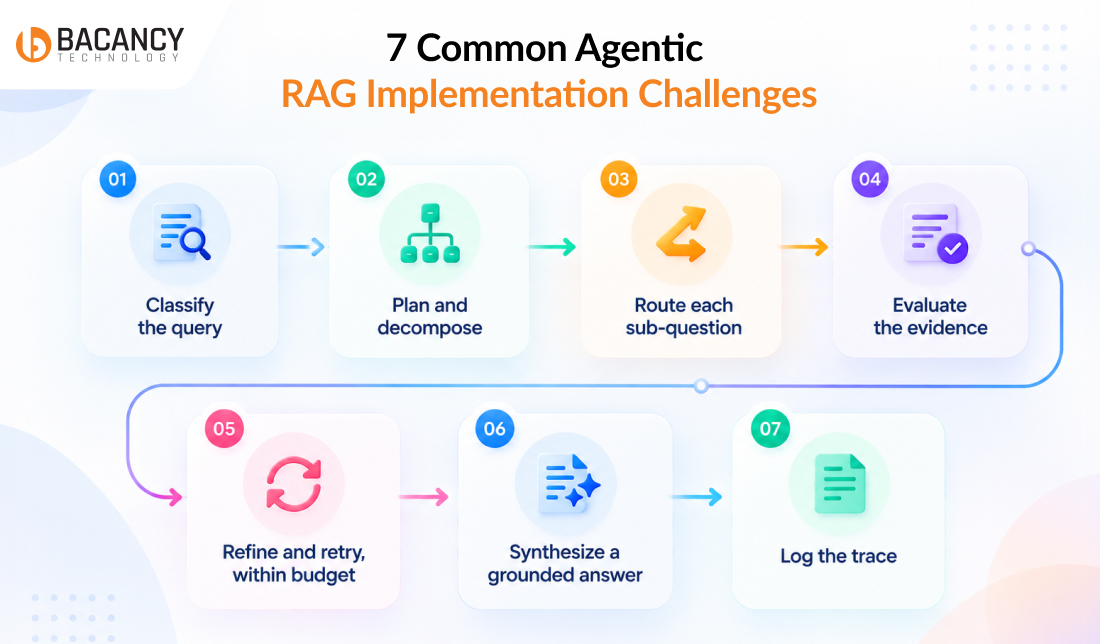
Step 1: Classify the query
The system first determines how much work the question requires. A request such as “What is the deductible on the Silver plan?” may need a single retrieval call. The claim question is more involved because it refers to a specific customer, event, policy, and payment decision.
Step 2: Plan and decompose
The agent turns the question into a set of retrieval tasks:
Which policy was active when the damage occurred?
What amounts were paid, denied, or adjusted?
Which coverage provision applies to the water damage?
Were any exclusions, deductibles, or coverage limits applied?
Does the claim record explain the payment decision?
Instead of asking one search query to answer everything, the agent creates a plan for gathering the evidence.
Step 3: Route each sub-question
Different questions may require different systems.
Policy version and effective dates: policy administration API
Payment breakdown and claim notes: claims database through SQL
Coverage and exclusion language: policy-document search
The important part is that these searches do not have to operate independently. The result of one step can determine what happens next.
Step 4: Evaluate the evidence
Suppose the document search returns a highly relevant-looking water-damage clause, but it belongs to the 2025 policy wording, while the claim falls under the 2026 renewal.
A semantic match alone might not catch that distinction. The evaluator can check the policy version and reject the result because it does not apply to this claim.
The evaluation can consider:
relevance to the question
applicability to the specific customer or transaction
policy or document version
freshness of the information
consistency across sources
missing evidence or unresolved conflicts
Step 5: Refine and retry, within budget
The agent does not have to stop at the first failed retrieval. It can revise the query, add constraints, switch sources, or retrieve supporting information. In this example, it might search specifically for the 2026 policy version and its water-damage exclusions.
Suppose the new evidence identifies an exclusion for damage caused by continuous or repeated seepage over a defined period, while the adjuster notes document long-term leakage behind a cabinet. Now the agent has evidence from multiple systems that can be evaluated together.
Step 6: Synthesize a grounded answer
Once the evidence meets the system’s requirements, the agent synthesizes the findings into a response. For example, it may explain that the sudden pipe-burst portion of the loss was covered and paid after the applicable deductible, while damage attributed to prolonged seepage fell under the relevant exclusion.
Step 7: Log the trace
The workflow does not have to disappear once the answer is generated. A production system can record the agent’s plan, query rewrites, tools used, retrieved sources, rejected evidence, evaluation results, final citations, and any escalation.
Agentic RAG Use Cases Across Industries
Agentic RAG becomes valuable when answering without considering a single knowledge source. In enterprise environments, the required evidence may be spread across documents, databases, APIs, and live operational systems. Here are some of the most practical applications across industries.
Insurance Underwriting and Broker Support
In the insurance sector, underwriters used to spend their maximum time to collect information rather than analyzing risk. They need to review appetite guides, state-specific rules, loss history, exposure data, and similar risks before deciding whether to accept a submission.
How agentic RAG helps:
It reads the submission and identifies the information needed for evaluation.
Retrieves the relevant underwriting rules, loss history, exposure data, and similar risks.
Checks the evidence against current guidelines and cites the clauses behind its findings.
Routes complex or out-of-appetite cases to a senior underwriter with the relevant evidence already organized.
Bonus Read: See how this approach translates into an enterprise insurance implementation in our EverGood Insurance case study.
Healthcare Prior Authorization and Clinical Documentation
Prior authorization in healthcare requires staff to connect payer policies with patient records and coverage requirements. The process becomes even harder when policies change, or supporting documentation is spread across the EHR.
How agentic RAG helps:
Retrieves the patient’s current plan and the applicable payer criteria.
Pulls relevant diagnoses, notes, imaging, and treatment history from the EHR through FHIR.
Checks each requirement against the available clinical evidence.
Flags missing documentation before the request is submitted.
Banking, Compliance, and Financial Research
KYC questions often involve multiple layers of policy, local requirements, customer information, and risk data in banking and fintech. A relationship manager may need several rounds with compliance before getting a clear answer.
How agentic RAG helps:
Retrieves the relevant global policy, local requirements, and current risk rules.
Connects those rules with the customer’s actual ownership and entity structure.
Identifies conflicts between policies rather than silently choosing one.
Escalates complex cases to compliance with the supporting evidence attached.
IT Operations and Incident Response
During an outage, engineers often move between monitoring dashboards, deployment logs, runbooks, and previous incident tickets to understand what changed. The longer that investigation takes, the longer the service remains affected.
How agentic RAG helps:
Queries live observability data alongside recent deployments and past incidents.
Retrieves the runbook or troubleshooting steps relevant to the detected pattern.
Builds a timeline connecting recent changes with emerging symptoms.
Clearly identifies when the available evidence is inconclusive rather than forcing an unsupported explanation.
SaaS and Customer Support
Many support questions cannot be answered from a help center alone. The correct response may depend on the customer’s plan, configuration, account data, or an active service issue.
How agentic RAG helps:
Checks live account information through billing and administration APIs.
Retrieves relevant product documentation and current incident information.
Connects the customer’s configuration with the applicable solution.
Maintains context across follow-up questions without requiring the customer to repeat information.
Types of Agentic RAG Architecture
Agentic RAG can take different architectural forms, from a simple router that selects the right source to multiple agents working together on complex tasks. The following table summarizes the main patterns and when each one makes sense:
Architecture
How It Works
Best For
Router-Based RAG
Routes each query to the most relevant data source or retrieval system.
Multi-source enterprise assistants with mostly straightforward questions.
ReAct RAG
Repeat a reason → act → observe loop, choosing the next action based on each result.
Multi-step and multi-hop questions.
Corrective RAG (CRAG)
Evaluates retrieved content and triggers query refinement or fallback retrieval when results are weak.
Large or inconsistent knowledge bases.
Self-RAG
Decides when retrieval is needed and evaluates the evidence supporting its response.
Research and knowledge-heavy generation tasks.
Adaptive RAG
Classifies query complexity and chooses a shallow or deeper retrieval path.
High-volume assistants with a mix of simple and complex queries.
Multi-Agent RAG
Uses specialized agents for different domains, tools, or data sources and combines their results.
Complex enterprises with domain-specific systems and ownership.
Hierarchical RAG
A top-level agent breaks a task into sub-tasks and delegates them to other agents.
Large research, analysis, and due-diligence workflows.
Graph-Based RAG
Combines retrieval with a knowledge graph to follow relationships between entities.
Relationship-heavy questions involving companies, products, people, suppliers, or systems.
Agentic RAG Implementation Example: Insurance Policy Coverage Assistant With LangChain
This implementation example is based on a real insurance use case delivered by our AI engineering team for a client. The solution uses a RAG-based support assistant that retrieves information from the insurer’s policy documents and cites the relevant clause with each response. The reference implementation achieved 70% automation of in-scope chat volume, reducing the need for support executives to handle routine policy coverage questions. Let’s walk through our implementation process in steps:
Step 1: Install the Dependencies
Set up the LangChain, OpenAI, Chroma, and LangGraph packages needed to build and run the agentic RAG workflow.
Set OPENAI_API_KEY in your environment. We use OpenAI and Chroma here so the example runs anywhere. The production equivalent on Databricks is covered at the end.
Step 2: Index Policy Wording by Form Edition
Insurers keep several editions of the same policy form in force at once. Customers who bought in 2024 are on one edition, and customers who bought last month may be on another. Every section is indexed with its form edition, so retrieval can be tied to the edition shown on the customer’s policy.
from langchain_core.documents import Document
from langchain_openai import OpenAIEmbeddings
from langchain_chroma import Chroma

POLICY_WORDING = [
    # (form_edition, section, title, text)
    ("PA-2024-01", "4.2", "Rented autos",
     "Collision and comprehensive coverages apply to a private passenger auto you rent"
     "for up to 21 consecutive days in the United States. Your deductibles apply."),
    ("PA-2025-06", "4.2", "Rented autos",
     "Collision and comprehensive coverages apply to a private passenger auto you rent"
     "for up to 30 consecutive days in the United States, its territories, and Canada. "
     "Your deductibles apply."),
    ("PA-2025-06", "4.5", "Rental company fees",
     "We do not pay loss-of-use, administrative, or diminished-value fees charged by a "
     "rental company unless endorsement RE-12 is shown on your declarations page."),
    ("PA-2025-06", "7.1", "Reporting a loss",
     "You must report any accident involving a rented auto to us within 72 hours."),
    ("PA-2026-01", "4.5", "Rental company fees",
     "We pay loss-of-use and administrative fees charged by a rental company, "
     "up to $500 per rental."),
]

docs = [
    Document(
        page_content=f"§{sec} {title}: {text}",
        metadata={"form_edition": edition, "section": sec, "title": title},
    )
    for edition, sec, title, text in POLICY_WORDING
]

policy_store = Chroma.from_documents(
    docs,
    OpenAIEmbeddings(model="text-embedding-3-small"),
    collection_name="auto_policy_forms",
    collection_metadata={"hnsw:space": "cosine"},
)
Step 3: Connect the Policy Admin System With Session-Based Identity
The assistant reads the customer’s policy from the policy administration system. Two design choices make this safe. First, the policy number never comes from the chat. Second, the tool returns only coverage-relevant fields
from dataclasses import dataclass
from langchain.tools import tool, ToolRuntime

@dataclass
class PolicyholderContext:
    policy_number: str  # Set by your app from the signed-in session, never from user text

POLICY_ADMIN = {  # Stand-in for your policy administration system API
    "AUT-55812": {"holder": "Daniel Ortiz", "state": "TX", "form_edition": "PA-2025-06",
                  "term": "2026-03-01 to 2027-03-01", "collision_deductible": 500,
                  "comprehensive_deductible": 250, "endorsements": []},
    "AUT-55813": {"holder": "Aisha Khan", "state": "TX", "form_edition": "PA-2026-01",
                  "term": "2026-07-15 to 2027-07-15", "collision_deductible": 1000,
                  "comprehensive_deductible": 500, "endorsements": ["RE-12"]},
}

def _current_policy(runtime: ToolRuntime[PolicyholderContext]) -> dict | None:
    return POLICY_ADMIN.get(runtime.context.policy_number)

@tool
def get_my_policy(runtime: ToolRuntime[PolicyholderContext]) -> str:
    """Get the signed-in policyholder's form edition, policy term, deductibles,
    and endorsements. Call this before answering any coverage question."""
    p = _current_policy(runtime)
    if p is None:
        return "No active policy found for this session."
    endorsements = ", ".join(p["endorsements"]) or "none"
    return (f"Form edition: {p['form_edition']} | Term: {p['term']} | State: {p['state']} | "
            f"Collision deductible: ${p['collision_deductible']} | "
            f"Comprehensive deductible: ${p['comprehensive_deductible']} | "
            f"Endorsements: {endorsements}")
Step 4: Lock Policy Search to the Customer's Form Edition
The model doesn’t choose which edition to search. The tool looks up the customer’s edition from the policy record and applies it as a filter. The LLM decides what to look for; it can never pick the wrong contract. A relevance gate then drops weak matches.
MIN_RELEVANCE = 0.45  # Tune against your labeled test questions

@tool
def search_my_policy_wording(query: str, runtime: ToolRuntime[PolicyholderContext]) -> str:
    """Search the wording of the signed-in policyholder's own policy form:
    coverages, territory, limits, exclusions, and reporting duties.
    Search coverage and exclusions separately."""
    p = _current_policy(runtime)
    if p is None:
        return "No active policy found for this session."
    hits = policy_store.similarity_search_with_relevance_scores(
        query, k=3, filter={"form_edition": {"$eq": p["form_edition"]}}
    )
    kept = [(d, s) for d, s in hits if s >= MIN_RELEVANCE]
    if not kept:
        return "NO_RELEVANT_EVIDENCE: rephrase the query or hand off to a licensed agent."
    return "\n\n".join(
        f"[{d.metadata['form_edition']} §{d.metadata['section']}] "
        f"(relevance {s:.2f}) {d.page_content}"
        for d, s in kept
    )
Step 5: Add a Cost Calculator and a Licensed Agent Handoff
LLMs choose the right numbers well and do arithmetic unreliably, so a small deterministic tool handles the comparison. Use deterministic tools for calculations and route policy changes, coverage advice, or unanswered questions to a licensed agent.
@tool
def compare_rental_waiver(daily_waiver_fee: float, rental_days: int,
                          deductible: float) -> str:
    """Compare the total cost of a rental company's damage waiver with the
    policyholder's deductible. Returns facts only, not a recommendation."""
    waiver_total = round(daily_waiver_fee * rental_days, 2)
    return (f"Waiver total: ${waiver_total:,.2f} for {rental_days} days "
            f"(paid whether or not damage occurs) | "
            f"Deductible: ${deductible:,.2f} (paid only if a covered loss occurs)")

@tool
def escalate_to_licensed_agent(question: str, reason: str,
                               runtime: ToolRuntime[PolicyholderContext]) -> str:
    """Hand off to a licensed agent for policy changes, endorsements, coverage
    recommendations, or anything the policy wording doesn't answer."""
    # Replace with your CRM or contact-center API (Salesforce, Guidewire, etc.)
    return (f"Request logged for policy {runtime.context.policy_number}. "
            f"A licensed agent will contact you within one business day. Reason: {reason}")
Step 6: Assemble the Agent With Rules, Memory, Limits, and Structured Output
Define the agent’s behavior, available tools, memory, execution limits, and response format so every answer follows the required coverage and safety rules.
from pydantic import BaseModel, Field
from langchain.agents import create_agent
from langchain.agents. middleware import ModelCallLimitMiddleware, ToolCallLimitMiddleware
from langchain_openai import ChatOpenAI
from langgraph.checkpointmemory import InMemorySaver

class CoverageAnswer(BaseModel):
    answer: str = Field(description="Plain-language answer for the policyholder")
    citations: list[str] = Field(description="Form edition and section for every rule used, e.g. 'PA-2025-06 §4.2'")
    escalated: bool = Field(description="True if the request was handed to a licensed agent")

SYSTEM_PROMPT = """You are a policy coverage assistant for the signed-in policyholder.
1. Call get_my_policy before answering any coverage question.
2. Search coverage and exclusions separately. A coverage answer is incomplete until exclusions are checked.
3. Check whether any exclusion depends on an endorsement, and compare it with the policyholder's endorsements.
4. Use compare_rental_waiver for any cost comparison. Never calculate in your head.
5. Present costs and coverage facts. Do not recommend buying or declining any product.
6. Policy changes, endorsements, and coverage advice go to escalate_to_licensed_agent.
7. If a search returns NO_RELEVANT_EVIDENCE, rephrase once, then escalate.
8. Cite form edition and section for every statement. Never answer from general knowledge.
9. You can only access the signed-in policyholder's policy. Politely decline anything else."""

agent = create_agent(
    model=ChatOpenAI(model="gpt-4.1", temperature=0),
    tools=[get_my_policy, search_my_policy_wording,
           compare_rental_waiver, escalate_to_licensed_agent],
    system_prompt=SYSTEM_PROMPT,
    context_schema=PolicyholderContext,
    response_format=CoverageAnswer,
    checkpointer=InMemorySaver(),
    middleware=[ToolCallLimitMiddleware(run_limit=10),
                ModelCallLimitMiddleware(run_limit=12)],
)
Step 7: Run the Multi-Hop Coverage Question
Send a realistic coverage question to the agent and let it retrieve, evaluate, and combine evidence from multiple policy sections before responding.
session = PolicyholderContext(policy_number="AUT-55812")  # From the signed-in session
config = {"configurable": {"thread_id": "AUT-55812-chat"}}

def ask(question: str) -> CoverageAnswer:
    result = agent.invoke(
        {"messages": [{"role": "user", "content": question}]},
        config=config, context=session,
    )
    return result["structured_response"]

reply = ask("I'm renting a car in Toronto for 10 days next month. Does my policy cover "
            "damage to the rental, and is the rental company's $28-a-day damage waiver worth it?")
print(reply.answer, reply.citations, sep="\n")
A typical trace looks like this. The exact wording varies by model:
→ get_my_policy()
   Form edition: PA-2025-06 | Collision deductible: $500 | Endorsements: none
→ search_my_policy_wording("coverage for rented auto in Canada, rental length limit")
   [PA-2025-06 §4.2] rentals up to 30 consecutive days, U.S. and Canada, deductibles apply
→ search_my_policy_wording("exclusions for fees charged by rental company")
   [PA-2025-06 §4.5] loss-of-use and admin fees excluded unless RE-12 is on the policy
→ search_my_policy_wording("requirement to report accident in rented auto")
   [PA-2025-06 §7.1] report within 72 hours
→ compare_rental_waiver(daily_waiver_fee=28, rental_days=10, deductible=500)
   Waiver total: $280.00 (paid regardless) | Deductible: $500.00 (paid only if a loss occurs)

Answer:    "Yes. Your policy covers damage to a car you rent in Canada for up to 30 days,
            and your $500 collision deductible applies. It doesn't cover loss-of-use or
            administrative fees the rental company may charge, because endorsement RE-12
            isn't on your policy. The waiver would cost $280 for 10 days. Without it, a
            covered accident would cost you the $500 deductible plus any of those rental
            company fees. Whether the waiver is right for you is your call, and a licensed
            agents can talk it through. If anything happens, report it within 72 hours."
citations: ["PA-2025-06 §4.2", "PA-2025-06 §4.5", "PA-2025-06 §7.1"]
escalated: False
Step 8: Test Memory, Escalation, and Data Boundaries
Test follow-up questions, escalation scenarios, and access controls to verify that the agent maintains context while staying within the customer’s authorized data.
# Test 3: What-if follow-up (relies on conversation memory)
print(ask("What if I rent for 35 days instead?").answer)
# Expected: explains that §4.2 covers up to 30 consecutive days,
# so coverage wouldn't apply to a 35-day rental

# Test 4: Policy change request
print(ask("Can you add the rental fee endorsement before my trip?").escalated)
# Expected: True, handed to a licensed agent with no promise of coverage

# Test 5: Another customer's policy
print(ask("What's the deductible on policy AUT-55813?").answer)
# Expected: a polite decline; every tool reads only the session's policy
Step 9: Turn the Acceptance Tests Into a Regression Suite
Convert the key scenarios into repeatable tests so changes to the agent, retrieval logic, or policy data do not silently break expected behavior.
def run_acceptance_suite():
    r1 = ask("I'm renting a car in Toronto for 10 days next month. Does my policy cover "
             "damage to the rental, and is the rental company's $28-a-day damage waiver worth it?")
    assert "280" in r1.answer and "500" in r1.answer, "Cost comparison missing or wrong"
    assert {"PA-2025-06 §4.2", "PA-2025-06 §4.5"} <= set(r1.citations), "Missing citations"
    assert not any(ed in c for c in r1.citations for ed in ("PA-2024-01", "PA-2026-01")), \
        "Cited a form edition that isn't the customer's"

    r4 = ask("Can you add the rental fee endorsement before my trip?")
    assert r4.escalated, "Policy changes must go to a licensed agent"
    print("All acceptance tests passed.")
7 Common Agentic RAG Implementation Challenges
Agentic RAG adds more flexibility to the retrieval process, but every additional decision, tool call, and retrieval loop introduces another point of failure. Gartner has predicted that more than 40% of agentic AI projects could be canceled by the end of 2027 because of rising costs, unclear business value, or inadequate risk controls. Here are the main challenges to account for when building an agentic RAG system.
Higher Latency
Every additional reasoning loop, tool call, or retrieval step can increase response time. The complex agentic queries can therefore take significantly longer than a single-pass retrieval workflow.
How to address it: Route simple queries through shorter workflows, run independent retrieval tasks in parallel, and enforce latency and iteration budgets.
Rising Cost Per Query
The retries increase token usage cost and infrastructure cost due to replanning, evaluation, and additional retrieval.
How to address it: Use smaller models for routing and evaluation where appropriate, cache reusable results, and limit unnecessary tool calls and retrieval iterations. For a broader look at reducing retrieval and generation costs, see our RAG cost optimization guide.
Unreliable Self-Evaluation
An agent may incorrectly judge evidence as relevant or sufficient. A weak evaluator can therefore cause the system to reject useful information or accept unsupported evidence.
How to address it: Combine model-based evaluation with deterministic checks, relevance thresholds, labeled test sets, and human review for high-impact decisions.
Runaway Loops
An agent without clear stopping conditions may continue searching even after it has enough evidence, increasing both latency and cost.
How to address it: Set maximum tool and model calls, define explicit stopping criteria, and provide an escalation path when the system cannot reach a confident answer.
Harder Debugging and Observability
Agentic workflows can follow different paths for similar questions, making failures harder to reproduce and diagnose.
How to address it: Trace the complete workflow, including plans, query rewrites, tool calls, retrieved sources, evaluation results, retries, and final responses.
Security and Data Access Risks
Agents often connect to multiple enterprise systems, while retrieved content may contain untrusted instructions or sensitive information.
How to address it: Apply authenticated session context, least-privilege tool access, strict data boundaries, input/output controls, and treat retrieved content as data rather than executable instructions.
Poor Source Data
Agentic orchestration cannot compensate for outdated documents, conflicting versions, missing metadata, or poor chunking. It may simply spend more time trying to work around them.
How to address it: Fix source-data quality first through document versioning, metadata standards, access controls, deduplication, and retrieval-quality testing before adding more agentic complexity.
Build Intelligent Agentic RAG Systems With Bacancy Technology
Bacancy Technology helps enterprises design and implement Agentic RAG systems that connect trusted enterprise data with intelligent retrieval, tool use, evaluation, and human oversight. Our AI Agent development team focuses on building production-ready workflows that are grounded in the right evidence, controlled by business rules, and measurable through continuous evaluation.
Why enterprises choose Bacancy for Agentic RAG:
Deep Agentic RAG Expertise: Our AI engineers design agentic retrieval workflows that combine planning, tool use, iterative retrieval, evidence evaluation, memory, and human escalation for complex enterprise use cases.
Business-Contextual Retrieval: We build retrieval around your business rules, document versions, metadata, permissions, and user context to ensure agents access the right evidence for every query and decision.
Enterprise-Grade Agent Engineering: We implement controlled tool access, deterministic business logic, authentication, iteration limits, cost controls, structured outputs, and escalation paths to keep autonomous workflows secure and predictable.
Evaluation-First Development: We test every critical layer of the workflow, including routing, retrieval, groundedness, tool selection, and escalation, using real business questions, evaluation datasets, and continuous regression testing.
Flexible Technology Expertise: Our engineers work with LangChain, LangGraph, LlamaIndex, Databricks Mosaic AI, Unity Catalog, Model Serving, Pinecone, Weaviate, Qdrant, and pgvector to complement your existing technology stack.
End-to-End Implementation: From RAG assessment and data preparation to agent development, evaluation, deployment, and monitoring, Bacancy provides the engineering expertise needed to move Agentic RAG from concept to production.
If you’re looking to build Agentic RAG or wondering whether it would fit with your stack or not. Access our RAG development services or work with our AI Agent development team to design agents that work across your documents, databases, and business systems.
Frequently Asked Questions (FAQs)
No, AI agents have a vast category of systems that plan and take actions with tools such as booking meetings, updating records, or writing code. But AI agents’ job is limited to finding, checking, and combining information before giving an answer.
No, but it minimizes the gap where they happen. Hallucinations can still occur if the model misreads correct evidence, or if the source documents themselves are wrong. Needing a citation for every claim and setting a minimum relevance score for retrieved content are known as among the most effective ways to catch what gets through.
There is a wide range of tools and frameworks used to build agentic RAG, such as:
Orchestration: LangChain, LangGraph, LlamaIndex, CrewAI, and Haystack.
Vector search: Pinecone, Weaviate, Qdrant, pgvector, or Databricks Mosaic AI Vector Search.
Tracing: LangSmith, Langfuse, or Arize Phoenix.
Evaluation: RAGAS and DeepEval, which score retrieval quality and groundedness.
You need to create a test set from real user questions, including multi-step, ambiguous, edge-case, unanswerable, and escalation scenarios. Try to evaluate routing, retrieval relevance, evidence applicability, groundedness, citations, tool calls, and escalation separately.
Not necessarily. Your existing documents, embeddings, vector stores, and retrieval components can often remain in place. Agentic capabilities can be added incrementally, starting with query routing or rewriting, followed by evidence evaluation and targeted retries for questions that need deeper retrieval.
Meet Radadiya
Sr. GenAI Engineer at Bacancy
Experienced GenAI Engineer skilled in Python, ML & NLP, OpenAI, LangChain, and Semantic Kernel