Quick Summary
Agentic AI in supply chain uses AI agents that track your live data, decide the best next step, and then carry out that step inside your ERP, WMS, or TMS within the limits you set. This guide covers where these agents deliver value first, how much control to give them, which risks to plan for, and how to go live in 90 days.
Table of Contents
Introduction
Most supply chain systems are good at raising alerts. When a shipment is late, or stock runs low, the system flags it right away. But the fix still depends on a planner, who has to review the issue and act on it manually.
Agentic AI in supply chain can take this process further. AI agents can assess the situation, choose the next step within set rules, and act on routine issues without waiting for manual input. Your team can focus on exceptions that need human judgment.
This is why the market in this sector is growing fast. Gartner expects spending on supply chain software with agentic AI to grow from under $2 billion in 2025 to $53 billion by 2030.
However, not every team is ready for this approach. In an October 2026 study by the Association for Supply Chain Management (ASCM) and the Digital Supply Chain Institute (DSCI), 83% of supply chain leaders said their employees are unprepared to use AI well.
The real challenge is not buying AI agents in supply chain operations. It is making sure they work safely and reliably every day. That is what makes agentic AI supply chain management difficult.
In this guide, we have covered a practical approach to agentic AI in supply chain, from choosing your first use case to a full 90-day rollout.
What is Agentic AI in Supply Chain?
Agentic AI in supply chain is a class of AI systems that track live data, choose the next step, and take action directly inside your ERP, warehouse (WMS), or transport (TMS) system, within limits your team sets. Unlike traditional analytics tools, it has 3 traits: it works toward goals, uses tools, and can act.
Gartner calls agentic AI a virtual workforce of agents that moves beyond insights to execution. It says these agents can plan, act, and adapt toward goals in complex environments.
Agentic AI vs AI Agents vs Traditional AI
The difference lies in their roles. AI agents in supply chain are individual workers, each handling a single task, such as replenishment or carrier calls. Agentic AI is the broader system that plans, coordinates multiple agents, and adapts to achieve a business goal. Traditional AI only follows fixed rules or supports human decisions.
| Question | Rules-Based Automation (RPA)
| Predictive AI
| GenAI Copilot
| AI Agent
| Agentic AI System
|
|---|
| What starts it?
| A preset rule
| Patterns in past data
| A user’s question
| A live event, such as a delay
| A business goal, such as on-time delivery
|
| Who decides what to do?
| The rule
| Human
| Human
| The agent, within set limits
| Several agents, within company policy
|
| Who carries it out? | Bot
| Human
| Human
| Agent | Several agents together
|
| What happens with an unexpected issue?
| It stops
| It flags the issue
| It suggests a fix
| It fixes simple cases
| It shares the work across agents
|
| What record does it keep?
| Sends an alert at a set level
| Predicts the shortage early
| Drafts a supplier email when asked
| Places a small reorder
| Reorders, books freight, and updates the customer
|
What Are the Benefits of Agentic AI in Supply Chain?
The major benefits of agentic AI in supply chain are faster decisions, lower costs, and more automation. Instead of waiting for a planner to act on every alert, AI agents in supply chain resolve routine issues as they happen, which means less firefighting for your team.
Supply chain leaders expect similar gains from AI. In the ASCM and DSCI study, they ranked these as the top payoffs over the next two years:
- Faster decisions (46%): Planning cycles get shorter because agents act on live signals.
- Lower costs (42%): Fewer manual steps reduce overall supply chain costs.
- More automation (40%): Agents handle routine issues, so planners can focus on complex exceptions.
Our take: In agentic AI supply chain management, the biggest win is speed, because agents cut the hours between spotting an issue and fixing it.
How Does Agentic AI Work in Supply Chain Operations?
Agentic AI in supply chain works in a four-step loop. Agents sense live signals, reason against goals and limits, act through system APIs, and learn from the outcome. For example, after a stockout alert, an agent checks stock at other sites, proposes a transfer, books it if it falls under your cap, and records the result.
The 4 Layers Behind AI Agents in Supply Chain
Every AI agent needs 4 layers. If one is missing, the agent either cannot act or acts at the wrong time.
- Data: Information from your ERP, WMS, TMS, supplier portals, sensors, and carrier updates. This is what the agent sees.
- Reasoning: An AI model that plans next steps using your rules, SOPs, and contracts. This is how it thinks.
- Action: Access only to the systems and tools each agent needs. This is what it can change.
- Guardrails: Spending limits, approval steps, activity logs, and an off switch. This is what keeps it in check.
The model gets the attention, but data and guardrails decide whether a pilot reaches production.
How Do AI Agents in Supply Chain Work Together?
One of Gartner’s top supply chain trends for 2026 is multi-agent systems. These are groups of AI agents that work together as a team, each handling its own task.
For example, when a supplier is late, one agent finds stock, another books freight, and a third updates the customer.
This teamwork depends on shared standards. The Agent-to-Agent (A2A) Protocol helps agents talk to each other. It reached version 1.0, its first stable release, and more than 150 organizations support it. It works alongside the Model Context Protocol (MCP), which connects agents to tools and data.
Top 8 Use Cases of Agentic AI in Supply Chain
The top use cases of agentic AI in supply chain are demand planning, replenishment, supplier risk, procurement, freight exceptions, disruption response, warehouse tasks, and returns. AI agents in supply chain work best on tasks that happen often, follow clear rules, and are easy to undo.
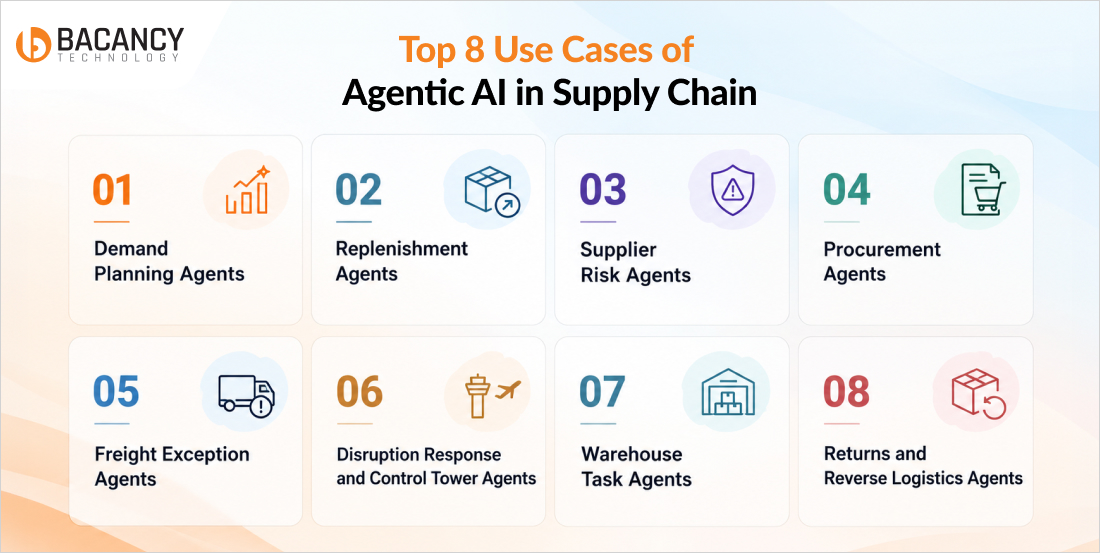
1. Demand Planning Agents
Instead of waiting for the next planning cycle, a demand planning agent updates forecasts daily using sales, promotions, and weather data. Changes in demand show up early, so you order the right amount and avoid empty shelves and extra stock.
2. Replenishment Agents
A replenishment agent watches stock against your targets and arranges transfers or orders before shelves run empty. Small orders under a set amount go through automatically, and bigger ones wait for approval. You keep stock available and spending in check.
3. Supplier Risk Agents
Supplier risk agents monitor supplier news, delivery records, and financial health. When a supplier starts to look risky, the agent flags the affected parts and suggests backup suppliers. You find out about problems sooner, while there is time to act.
4. Procurement Agents
Procurement agents compare quotes, check contract terms, and prepare purchase orders, but a buyer always approves them. Boston Consulting Group (BCG) found companies using them save 8% to 15% on costs and finish sourcing in 30% to 60% less time.
5. Freight Exception Agents
When a pickup is missed, freight exception agents call the carrier, rebook the shipment, and keep the customer updated. At C.H. Robinson, one agent makes the calls, and another decides the next step. They resolve hundreds of shipments a day.
6. Disruption Response and Control Tower Agents
Supply chain teams spend 28% of their time on disruptions, mostly finding out what happened (Knosc). Disruption response agents take over that work. They check which orders a delay affects, suggest recovery steps, and apply fixes you approved in advance.
7. Warehouse Task Agents
On a busy day, warehouse task agents assign picking jobs, balance staff across zones, and reshuffle work when a rush order arrives, so orders keep moving. Because they direct people, the EU AI Act may treat these agents as high-risk.
8. Returns and Reverse Logistics Agents
Each returned item needs a decision: resell, repair, or recycle. Returns agents check each item, decide by set rules, and issue the refund. Customers get their money back faster, and you recover more value from items that might sit unused.
Ready to put agentic AI in supply chain operations to work?
Our AI agent development services build AI agents in supply chain workflows that take routine work off your team.
Real-World Examples of Agentic AI in Supply Chain
AI agents in supply chain operations are already showing real results. Logistics provider C.H. Robinson uses them to clear missed freight pickups, and a global consumer goods company uses them to manage replenishment.
How C.H. Robinson Uses AI Agents to Move Freight Faster
C.H. Robinson’s teams once spent over half the day chasing missed less-than-truckload (LTL) pickups. Now one AI agent calls carriers and another decides what happens next.
The company reports that 95% of missed-pickup checks are now automated, saving over 350 hours of manual work a day. Freight moves up to a day faster, and unnecessary return trips have dropped by 42%.
This is part of a larger system. Hundreds of connected AI agents now work across C.H. Robinson’s operations. Its two-year analysis (2024 to 2026) found that AI-handled shipments reached market 11% faster on average, with 7% better on-time pickups. (Source)
How a Consumer Goods Company Cut Admin Costs with AI Agents
BCG shares the case of a global consumer goods company whose supply chain team spent much of its time fixing problems after they happened. That changed once its managers began working with AI agents. The agents suggested stock moves early, like store transfers and rush orders. Fill rates and in-stock levels improved. Administration costs fell 40% to 60%.
How Much Freedom Should AI Agents Have in an Autonomous Supply Chain?
The right level of autonomy for AI agents in supply chain depends on 2 things: how costly a wrong decision is and how easily you can undo it. Cheap and reversible? Let the agent act. Costly and permanent? Keep a human in charge.
Most companies using agentic AI in supply chain are still cautious. Only 37% of operations leaders are comfortable letting AI agents run full end-to-end processes (PwC, 2026). Gartner also advises setting the right level of human oversight, especially early on.
Move toward an autonomous supply chain one level at a time:
- Inform: The agent alerts a person.
- Recommend: It suggests, and a person decides.
- Act with approval: It prepares the action and waits for a yes.
- Act and report: It acts first and tells you right away.
- Act within limits: It acts alone inside caps you set, with every action logged.
Here’s Bacancy’s Autonomy Decision Matrix:
| Decision | Reversibility
| Cost of error
| Level
| Approver
|
|---|
| Reorder under a value cap
| High
| Low
| Act within limits
| None, logged
|
| Carrier rebooking
| High
| Medium
| Act and report
| Transport lead, daily review
|
| New supplier award
| Low
| High
| Recommend
| Procurement head
|
| Price change
| Medium
| High
| Act with approval
| Pricing manager
|
| Production schedule change
| Medium
| High
| Act with approval
| Plant planner
|
Note: In agentic AI supply chain management, move a decision up one level only after 30 days of clean logs.
What Are the Risks of Agentic AI in Supply Chain and How to Fix Them?
The 4 main risks of agentic AI in supply chain are poor data, weak security, an unready workforce, and compliance gaps. Each has a practical fix, which strong agentic AI supply chain management builds in from day 1.
1. Poor Data Quality
PwC found 87% of operations and supply chain leaders say poor data quality has slowed their digital and AI initiatives. AI agents in supply chain that work on bad data simply make bad decisions faster.
How to fix it: Clean the data your first workflow needs, assign an owner to it, and check inputs before the agent acts. This is where data engineering services help most.
2. AI Agent Security Gaps
The OWASP Top 10 for Agentic Applications 2026 covers risks such as hijacked goals, misused tools, too much access, and rogue agents. For example:
- A fake supplier email hides instructions that take over an agent’s goal.
- An agent with too much access places purchase orders it should only draft.
- One agent’s mistake spreads into other agents’ orders and shipments.
How to fix it: Treat every incoming document as untrusted, give each agent only the access it needs, cap spending per action, and keep an off switch.
3. Workforce Readiness
In the ASCM and DSCI study, only 17% of organizations have an AI-ready workforce, and they report a 71% project success rate. Everyone else reports 28%.
Gartner adds that 86% of supply chain leaders expect agentic AI to require new ways of building talent.
How to fix it: Train planners to review agent decisions and handle exceptions, and involve them early so they help set the rules.
4. Compliance and Regulation
Warehouse agents that assign tasks to workers or track their performance may count as high-risk under the EU AI Act. After the Digital Omnibus update, those rules apply from December 2, 2027.
How to fix it: Classify each agent’s risk now and keep a person involved in decisions that affect workers.
Are poor data and disconnected systems limiting your supply chain AI results?
Our data engineering services unify your data so AI agents in supply chain can act on accurate information.
Which Agentic AI Platform Is Right for Your Supply Chain?
There are 3 routes to agentic AI in supply chain: use agents built into your ERP, buy a specialist platform, or build custom agents on your own data. Pick based on how standard your processes are and how much control you need.
AI Agents Built into Your ERP (SAP and Oracle)
SAP Joule agents and Oracle Fusion Cloud SCM agents suit companies that already run on those suites. In 2026, SAP announced 60+ supply chain agents. Oracle offers AI Agent Studio for building custom agents.
Blue Yonder says its agents take controlled actions in WMS, TMS, and OMS rather than offering recommendations, and every action is logged and reversible. Kinaxis Maestro Agents work inside live planning, built to plan with the planner, not for them, and Maestro Agent Studio lets teams build their own.
Custom AI Agents Built on Your Own Data
Custom AI agents in supply chain make sense when your workflows or data give you an edge, or you run older systems no single vendor covers well. You keep full control of the logic.
| Route | Best fit
| Speed
| Control
| Lock-in risk
|
|---|
| ERP-native agents
| Companies on one ERP suite
| Fast
| Low
| High
|
| Specialist platform
| Planning-heavy teams
| Medium
| Medium
| Medium
|
| Custom agents
| Unique workflows, mixed systems
| Slower start
| High
| Low
|
| | | | |
What Drives the Cost of AI Agents in Supply Chain?
In agentic AI supply chain management, costs come from 5 drivers, and integration often costs more than the AI model. PwC found integration complexity is the top reason technology investments fall short, cited by 52%.
| Cost driver
| What raises it
| How to control it
|
|---|
| Data preparation
| Messy product and supplier data
| Scope to one workflow first
|
| System integrations
| Legacy ERP, no APIs
| Reuse connectors, adopt MCP
|
| Model and API usage
| Long prompts, high volume
| Reuse answers, smaller models for simple tasks
|
| Guardrails and monitoring
| High-risk actions
| Match controls to autonomy level
|
| Change management and training
| Large, untrained teams
| Train power users first
|
How to Implement Agentic AI in Supply Chain: A 90-Day Roadmap
A 90-day rollout of agentic AI in supply chain has 3 phases:
Days 1 to 30: Pick One Workflow and Set Baselines
Choose a high-volume, low-risk workflow where mistakes are easy to undo, such as missed-pickup checks or small reorders. Record today’s KPIs, like hours spent and exception rates. Then make sure the data is complete, current, and has a clear owner.
Days 31 to 60: Test Agents in Shadow Mode
Run the agent in shadow mode, which means it suggests actions, but your team still decides. Set limits on what it can access, and record each suggestion. Then compare its choices with your team’s. Where they differ, adjust the rules.
Days 61 to 90: Expand Autonomy and Measure ROI
Move proven decisions up one level, for example from “recommend” to “act with approval.” Then measure ROI with 4 metrics: hours saved, exception rate, cost per decision, and KPI change against your baseline. If all 4 improve, expand to the next workflow.
How Bacancy Helps with Agentic AI in Supply Chain
Bacancy Technology is an AI-powered consulting and software development partner that helps enterprises put agentic AI in supply chain operations to work. Our team helps you:
- Choose the right first workflow and check data readiness
- Build custom agents connected to your ERP, WMS, and TMS
- Set guardrails and autonomy levels for each decision
- Test in shadow mode and track ROI before scaling
- Monitor and improve agents after go-live
Founded in 2011, Bacancy has 1,050+ engineers, serves 500+ enterprises across 30+ countries, is ISO/IEC 27001:2022 certified, and keeps a 98% client retention rate.
Conclusion
Agentic AI in supply chain delivers real results only when the basics are in place, from clean data and tight permissions to a trained team and autonomy that grows with proof. So start with one easy-to-reverse workflow, test it in shadow mode, and scale once the results hold. If you need expert support, our logistics IT services team can help you launch your first agent.
Frequently Asked Questions (FAQs)
No. Generative AI creates content, such as a supplier email. Agentic AI in supply chain takes action, like rebooking a shipment, and often uses generative AI as one tool.
Costs in agentic AI supply chain management depend on data, integrations, model usage, and guardrails. Integration often costs more than the model, so starting with one workflow keeps spending low.
Yes. SAP and Oracle offer built-in agents for their own suites. For older ERP systems, custom agents connect through APIs, MCP servers, or middleware, so plan the integration work early.
With ready data, a first agent can move from pilot to limited autonomy in about 90 days. Adding more workflows takes longer, since each one needs its own testing phase.